Understanding Autonomous AI in Business: The Next Evolution of Automation
Businesses have always looked for ways to improve efficiency, reduce operational workload, and serve customers faster. Over the past decade, automation tools have helped organizations simplify repetitive tasks. However, traditional automation still relies heavily on human supervision.
Today, a new generation of technology is emerging — Autonomous AI systems.
Unlike traditional automation tools, autonomous AI can manage workflows, make decisions within defined parameters, and carry out business processes with minimal human involvement.
This shift is transforming how modern businesses operate.
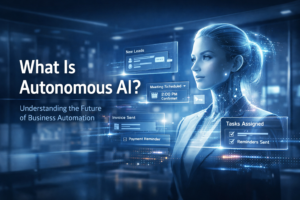
What Is Autonomous AI?
Autonomous AI refers to systems that are capable of performing tasks, managing workflows, and responding to events without constant human input.
Traditional automation works through predefined triggers. For example:
- When a form is submitted → send an email
- When a meeting is booked → send a confirmation
Autonomous AI goes further by understanding operational patterns and coordinating multiple tasks automatically.
Instead of performing a single action, autonomous AI can manage a chain of actions such as:
- Capturing a lead
- Initiating communication
- Scheduling a meeting
- Assigning internal tasks
- Sending reminders
- Generating invoices
- Following up on payments
All within one intelligent workflow.
The Limitations of Traditional Business Automation
Many businesses already use software tools for CRM management, scheduling, invoicing, or marketing automation. While these tools improve efficiency, they often require constant manual coordination.
Some common challenges include:
- Staff needing to track follow-ups manually
- Delays in responding to leads
- Scheduling conflicts between teams and clients
- Administrative workload increasing with business growth
- Multiple disconnected systems managing different tasks
As businesses grow, these operational complexities can slow down productivity and affect customer experience.

How Autonomous AI Improves Business Operations
Autonomous AI systems are designed to connect and manage operational workflows intelligently.
Instead of employees manually coordinating multiple tools, an autonomous AI system can monitor events and trigger appropriate actions automatically.
For example, when a potential customer contacts a business:
- The system captures the inquiry
- Sends an immediate response
- Schedules a meeting based on availability
- Notifies the appropriate team member
- Sends reminders before the meeting
- Generates follow-up tasks after the interaction
This reduces delays and ensures consistent communication with clients.
Benefits of Autonomous AI for Businesses
Organizations that adopt autonomous AI systems can experience several operational advantages.
Faster Response Times
AI systems can respond instantly to customer inquiries, ensuring no leads are missed.
Reduced Administrative Work
Tasks such as scheduling, reminders, and follow-ups can be handled automatically.
Improved Operational Efficiency
Teams spend less time on coordination and more time on strategic work.
Consistent Customer Experience
Automated workflows ensure every client receives timely communication and follow-ups.
Scalable Operations
Businesses can handle larger volumes of inquiries and transactions without proportionally increasing staff.
Industries Benefiting from Autonomous AI
Autonomous AI solutions can be implemented across various industries that rely on operational coordination and client communication.
Some examples include:
- Healthcare clinics managing appointments and patient communication
- Real estate agencies handling property inquiries and meeting scheduling
- Service-based businesses coordinating projects and client interactions
- Multi-location organizations managing centralized operations
- Professional service providers managing consultations and invoicing
In each case, autonomous AI helps streamline workflows and maintain operational consistency.
The Future of Business Operations
As technology continues to evolve, businesses are shifting from manual management of processes to intelligent operational systems.
Instead of relying solely on staff to coordinate daily activities, organizations are implementing AI-driven systems that ensure operations run smoothly in the background.
Autonomous AI represents the next step in this evolution — combining automation, intelligent decision-making, and workflow coordination into a unified operational system.
Businesses that adopt these technologies early are better positioned to scale efficiently and maintain high levels of service.
Final Thoughts
Automation has already changed the way businesses operate, but autonomous AI is taking this transformation further.
By reducing operational friction and enabling intelligent workflow management, autonomous systems allow organizations to focus more on growth, innovation, and customer relationships.
As businesses continue to embrace digital transformation, autonomous AI will play an increasingly important role in shaping the future of work
Keyob: Improving the Knowledgbase.
Aleesa Onboarding Process
- Requirements Gathering – An initial session to define objectives, key use cases, customer engagement needs, and required workflows.
- Knowledge Base Integration – Incorporating your documents, FAQs, and website content to establish the chatbot’s knowledge foundation.
- Customization & Training – Configuring conversation flows, automations, and the chatbot’s tone to align with your brand identity and operational processes.
- Workflow Automation Setup – Enabling task-driven capabilities such as appointment scheduling and process-specific automations.
- Testing & Quality Assurance – Running comprehensive test scenarios, reviewing performance, and refining both conversational responses and automated workflows.
- Deployment – Launching the chatbot across selected channels with integrated automation features.
- Ongoing Support & Optimization – Continuous monitoring, updates, and enhancements to ensure the chatbot evolves with your business needs.